

Crate Size Calculator: Find the Right Crate for Your Dog — Comfortable, Safe, and Properly Sized
A crate is one of the most useful things you can give your dog — but only if it’s the right size. Too small and it’s uncomfortable, potentially painful, and stressful. Too large and it loses its value as a safe, den-like space, and puppies will simply use one corner as a bathroom. Getting the size right matters more than most people realize, and it’s easier than it sounds when you have the right measurements and know what to look for.
What is a Crate Size Calculator?
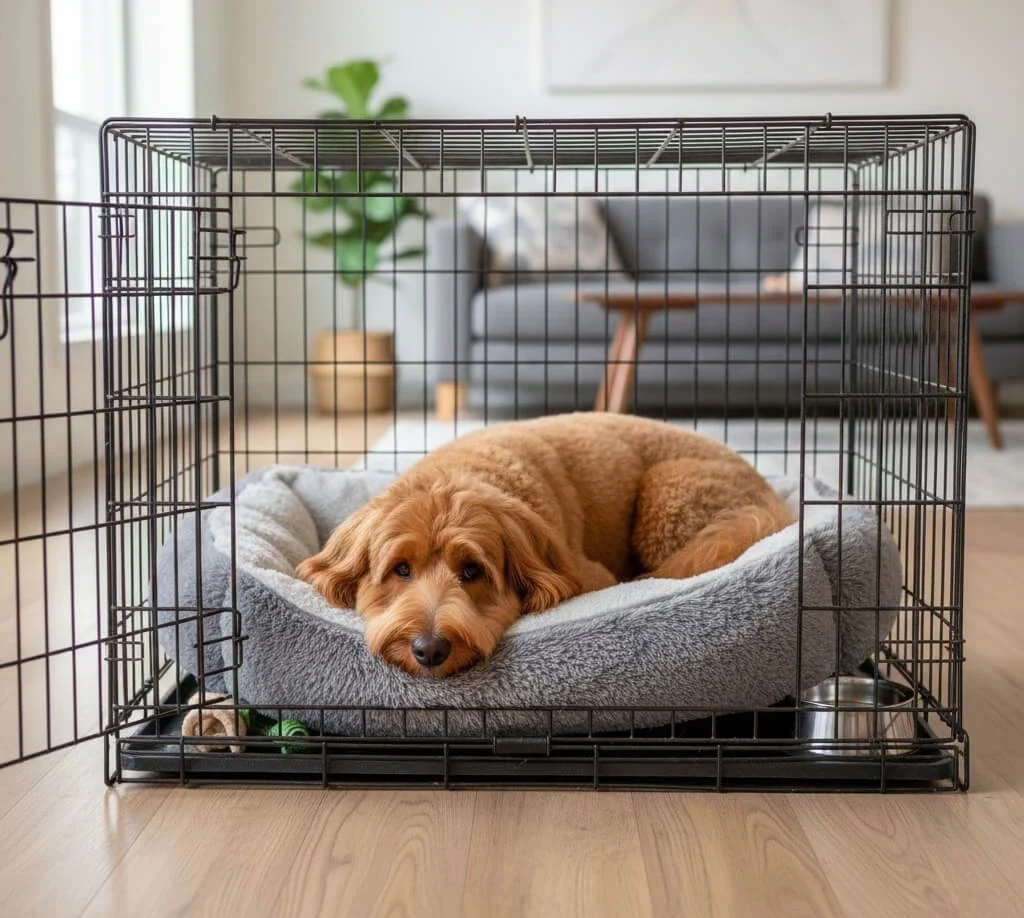
A crate size calculator takes your dog’s body measurements and tells you the minimum crate dimensions they need to be comfortable — the length, height, and width of crate that gives your dog enough room to stand up fully, turn around in a complete circle, and lie down stretched out. These are the three non-negotiables for a properly sized crate, and they’re determined by your dog’s body length and shoulder height, not by breed name or weight alone.
Weight is a useful cross-reference but a surprisingly poor predictor of crate size on its own. A lean Greyhound and a stocky Bulldog can weigh exactly the same but need very different crates. Body length is the measurement that drives crate sizing, and shoulder height determines how tall the crate needs to be. This calculator uses both.
If you’re also sorting out a harness for your dog, our Harness Size Calculator works the same way — measurements in, correct size out. Both tools together give you everything you need to set up comfortable, properly-fitted equipment for your dog.
How to Measure Your Dog for a Crate
Two measurements are all you need. Take them carefully and the rest is straightforward.
Measurement 1 — Body Length (nose to tail base)
Stand your dog on a flat surface. Measure from the tip of the nose to the base of the tail — not the tip of the tail, which adds unnecessary length. Keep the measuring tape along the spine, following the curve of the back. This is the measurement that determines crate length. Add 10–15 cm to this number and that’s the minimum internal crate length your dog needs. The calculator does this addition automatically.
Measurement 2 — Shoulder Height (floor to shoulder)
Measure from the floor to the top of the shoulder blades — the highest point of the back, which is the shoulder, not the head. This determines how tall the crate needs to be. Add 10 cm to this measurement for the minimum internal crate height. A dog that can stand fully upright without hunching is a dog that’s comfortable in their crate.
A note on measuring puppies
For puppies under six months, measure current size but buy for adult size. A puppy’s adult size can be estimated from breed standards. If you buy a crate for adult size, use a divider panel — which most wire crates include — to reduce the usable space to the puppy’s current size. As they grow, move the divider. This saves money and makes training far more effective.
How to Use This Calculator
Enter your dog’s name, age, body length, and shoulder height. Add weight if you have it — it helps cross-check the result. Select the primary use for the crate: home use, puppy training, travel, or sleeping. Click the button and you’ll get the recommended crate size category, the minimum dimensions to look for when shopping, a full size chart showing where your dog sits, and a crate type recommendation tailored to how you plan to use it.
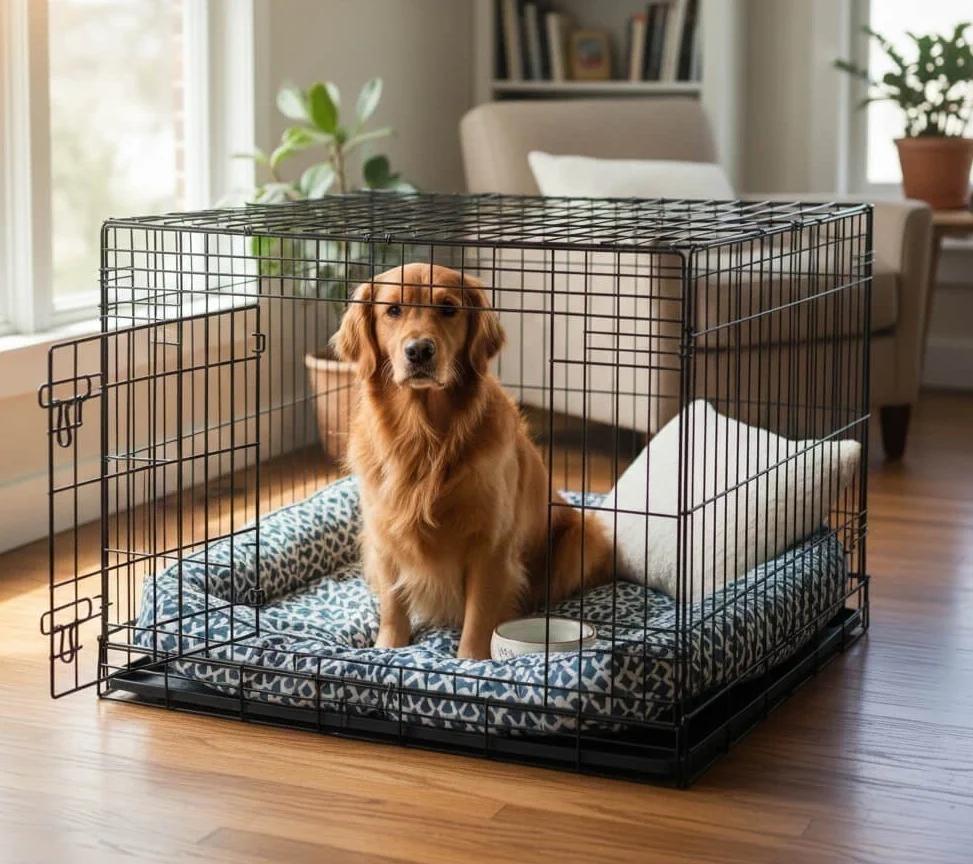
Pay attention to the borderline notes. If your dog’s length is near the top of a size category, the calculator will flag it and suggest sizing up. Always buy to the upper edge of your dog’s measurement, not the lower — a slightly larger crate is always better than one that’s slightly too small.
Crate Size Chart — Full Reference
XS (Extra Small) — Dog up to 38 cm, Crate approx. 46–50 cm length
Chihuahuas, Yorkshire Terriers, Pomeranians, and other toy breeds. Lightweight wire or plastic crates work well. These dogs often prefer an enclosed, den-like atmosphere — a crate cover helps create that feeling.
S (Small) — Dog 38–52 cm, Crate approx. 53–61 cm length
Shih Tzus, Miniature Poodles, Maltese, Cavalier King Charles Spaniels. A top-opening door design makes it easier to lift smaller dogs in and out, particularly useful for older dogs or those with mobility issues.
M (Medium) — Dog 52–68 cm, Crate approx. 61–76 cm length
Beagles, Cocker Spaniels, Border Collies, Bulldogs. The widest category in terms of breed variety. Wire crates with a divider panel are the most practical choice — the divider lets you adjust the usable space as a puppy grows without buying multiple crates.
L (Large) — Dog 68–88 cm, Crate approx. 76–107 cm length
Labradors, Golden Retrievers, German Shepherds, Siberian Huskies. At this size, look for double-door designs — the extra door at the side gives you more flexibility in where you place the crate in the room. Folding wire crates in this size range are still manageable to move.
XL (Extra Large) — Dog 88–110 cm, Crate approx. 107–122 cm length
Rottweilers, Dobermans, Weimaraners, Standard Poodles. Crate placement matters more at this size — large dogs are more sensitive to environment. A quiet, low-traffic corner reduces resistance to crating and helps the dog settle faster.
XXL (Extra Extra Large) — Dog 110 cm+, Crate 122 cm+ length
Great Danes, Saint Bernards, Mastiffs, Newfoundlands, Irish Wolfhounds. Standard retail crates often don’t go this large. An exercise pen (x-pen) is worth considering for giant breeds — it provides more space, is configurable, and many giant breeds find traditional crates too confining. If using a crate, heavy-gauge steel construction is non-negotiable.
Types of Dog Crates — Which Is Right for Your Situation?
Wire Crates
The most versatile option for most dogs and most situations. Good ventilation, folds flat for storage, easy to clean, and available in every size. Most come with a divider panel — essential for puppy training. A crate cover converts it into a den-like sleeping space. The right choice for home use in the majority of cases.
Plastic (Airline) Crates
More enclosed than wire, which some dogs find more comfortable and calming. IATA-approved models are required for air travel. Also practical for car travel, fitting neatly into boot spaces. Harder to clean after accidents but easier to carry. Good for anxious dogs who prefer a darker, more den-like environment.
Soft-Sided Crates
Lightweight, portable, and easy to set up. Suitable only for calm, fully trained adult dogs that aren’t prone to chewing or scratching. Not appropriate for puppies, anxious dogs, or escape artists — the fabric panels give way easily. Best for travel or temporary use with a reliably settled dog.
Heavy-Duty Steel Crates
Designed for dogs that destroy or escape from standard crates. Welded steel construction, heavy-duty locks, and reinforced corners. Expensive and heavy, but necessary for certain dogs. If your dog has damaged multiple standard crates, this is worth the investment — persistent escape attempts are stressful for the dog as well as frustrating for you.
Furniture / Wooden Crates
Designed to blend with home decor — they look like side tables or cabinets. Suitable only for calm, fully crate-trained adult dogs. Not practical for crate training, puppies, or dogs that chew. A good aesthetic choice once the training phase is completely behind you.
Crate Training Tips — Making the Crate a Place Your Dog Wants to Be
A properly sized crate is the foundation. But the best crate in the world won’t work if your dog associates it with punishment or stress. A few things make a real difference:
Introduce it gradually.
Don’t put your dog in the crate and close the door on day one. Leave the crate open with comfortable bedding inside. Let your dog investigate at their own pace. Put treats or toys near and then inside the crate over the first couple of days. The goal is for your dog to go in voluntarily before you ever close the door.
Never use the crate as punishment.
The crate needs to be a positive space — somewhere your dog goes to rest, not somewhere they’re sent when they’ve done something wrong. If the crate becomes associated with punishment, you’ll spend months undoing that association. Keep your tone calm and positive whenever the crate is involved.
Build up duration slowly.
Start with the door closed for just a minute or two while you’re in the room. Gradually increase the time, always returning before your dog becomes distressed. Most adult dogs can comfortably spend 3–4 hours in a crate during the day once properly trained — puppies much less, and no dog should spend more than 6 hours in a crate.
Keep it the right size throughout.
As your puppy grows, keep adjusting the divider so the usable space matches their current size. A crate that was perfect at 10 weeks may be too small by 16 weeks. Re-measure every month for puppies and use the Crate Size Calculator as a reference whenever you’re unsure.
Frequently Asked Questions (FAQ)
How do I know if the crate is the right size?
Your dog should be able to stand up without their head touching the roof, turn around in a complete circle without bumping the sides, and lie down fully stretched out. If any of those three things aren’t possible, the crate is too small. If there’s significantly more space than needed and your dog is using a corner as a bathroom, the crate is too large — use a divider to reduce the space.
Can I use a puppy crate for an adult dog?
Only if the adult size happens to fit the crate — which is uncommon unless you have a small breed. Most puppies outgrow their first crate within a few months. Buying an adult-sized crate with a divider from the start is almost always more cost-effective than buying multiple crates as the puppy grows.
My dog refuses to go into the crate — what’s wrong?
Usually one of three things: the crate was introduced too quickly, the dog associates it with something negative, or the size is wrong and they’re physically uncomfortable inside. Start the introduction process from scratch — open door, treats inside, no pressure. If they enter willingly but seem uncomfortable inside, re-measure and check whether the crate is actually large enough for them to stand and turn around freely.
How long can I leave my dog in a crate?
Adult dogs: a maximum of 4–5 hours during the day for most dogs, up to 8 hours overnight if they’re fully settled. Puppies: roughly one hour per month of age, up to a maximum of 3–4 hours during the day. A puppy that’s four months old shouldn’t be in a crate for more than 4 hours at a stretch. Exceeding these limits consistently causes anxiety, physical discomfort, and can set back training significantly.
Does crate size affect crate training success?
Significantly. A crate that’s too large is one of the most common reasons puppy crate training fails — the dog simply uses one end as a sleeping area and the other as a bathroom. Reducing the space with a divider panel so the dog has just enough room to stand and turn around removes this option and accelerates training considerably. Size matters more for training than most people expect.
Explore More Dog Tools
The Crate Size Calculator is part of a complete set of free tools at Dog Pregnancy Calculator — covering everything from pregnancy tracking and breeding tools to practical everyday resources. If you’re also shopping for a harness, our Harness Size Calculator gives you the right fit in the same straightforward way. Browse all calculators by category to find what you need.
| Size | Dog Length | Crate Length | Crate Height | Typical Weight | Breed Examples |
|---|