Know Exactly What's Happening — and What to Do — Every Week of Your Dog's Pregnancy
A due date tells you when the pregnancy ends. A pregnancy stage tracker tells you everything in between. It takes your dog’s mating date and maps the full 63-day journey onto a week-by-week timeline — what’s developing inside her right now, what physical changes to expect, what actions to take, and what to watch out for. That’s the difference between anxiously counting days and actually being prepared.

What Is a Pregnancy Stage Tracker?
A pregnancy stage tracker shows you exactly where your dog is in her pregnancy today — which week she’s in, what developmental stage the puppies are at, and what you should be doing right now. Think of it as the difference between having a destination and having a full map. Our Dog Due Date Calculator gives you the destination. This tracker gives you the route — week by week, milestone by milestone, from fertilization to birth.
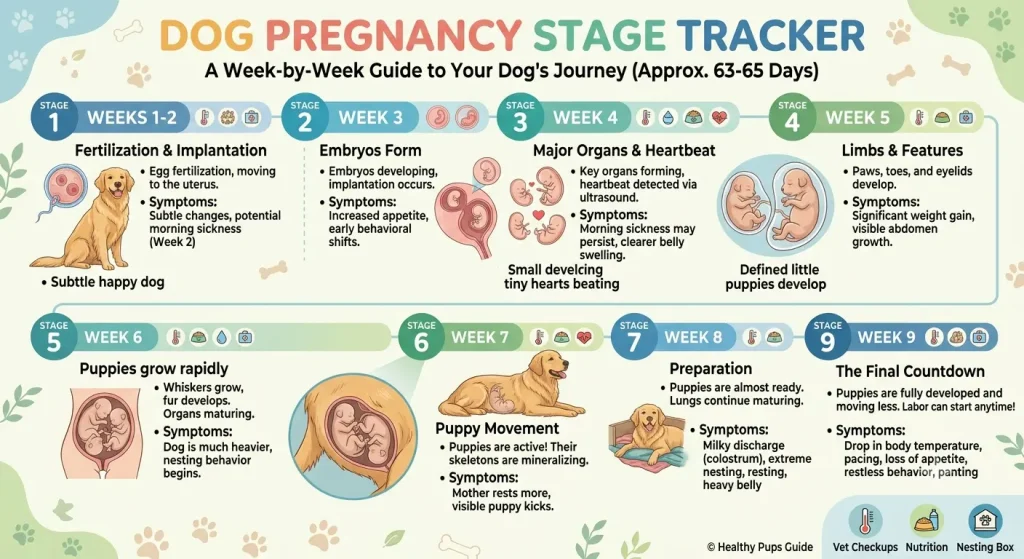
The Nine Weeks of Dog Pregnancy
Week 1 (Days 1–7): Fertilization and Early Cell Division
After mating, fertilization occurs within 48–72 hours. The fertilized eggs travel down the fallopian tubes while dividing rapidly. By the end of week one they’ve reached the uterus. Your dog shows no outward signs — she eats, plays, and behaves exactly as normal. Record the mating date accurately. That’s the only action needed this week.
Week 2 (Days 8–14): Implantation Begins
Around day 10–12, the embryos implant into the uterine wall. The embryos are still microscopic but development has begun in earnest. Some dogs show subtle signs: a slight change in appetite, mild lethargy, or marginally more affectionate behavior. Most show nothing at all — both are equally normal. Avoid unnecessary medications, flea treatments, or vaccinations during this period.
Week 3 (Days 15–21): Organ Formation Begins
The nervous system, heart, and major organs begin forming. By day 21 a skilled vet may detect pregnancy through palpation, though ultrasound is the reliable option. Book a vet appointment this week — the ideal window for ultrasound confirmation is days 25–28, so booking now means it’s in the diary.
Week 4 (Days 22–28): Pregnancy Confirmed
This is the best week for ultrasound. Fluid-filled sacs are clearly visible and your vet can give a rough puppy count. Your dog’s belly looks visibly fuller and her nipples enlarge. Nutritional needs begin rising — start gradually increasing her daily food by around 10–15% this week.
Week 5 (Days 29–35): Rapid Fetal Development
The fetuses develop toes, claws, eyelids, and sex organs. By day 35 they measure 3–4 cm. Her appetite increases noticeably. Switch fully to a high-quality puppy food and increase daily calories by 25–30%. Keep exercise gentle — short walks only.
Week 6 (Days 36–42): Skeletons Forming, Movement Visible
The puppies’ skeletons are now calcified enough for an X-ray — the most accurate puppy count available. You may see or feel movement in her abdomen. Introduce the whelping box this week and let her explore it at her own pace.
Week 7 (Days 43–49): Nesting Behavior Begins
Puppies are fully formed and simply gaining weight. You’ll notice the nesting instinct — rearranging bedding, seeking quiet corners, becoming more reclusive. Keep her environment calm. Have all whelping supplies purchased and organized.
Week 8 (Days 50–56): Final Countdown
Birth is close. Her abdomen is at maximum size. Milk production often begins. Start taking her rectal temperature twice daily and recording every reading. A temperature drop below 99°F (37.2°C) that stays there is your most reliable signal that labor is imminent — typically within 12–24 hours.
Week 9 (Days 57–68): Whelping
Most dogs deliver between day 58 and day 68, with day 63 being the average. Stay close, stay calm, and know the warning signs. For a dedicated live countdown with milestones, use our Whelping Date Countdown alongside this tracker.
Nutrition Through the Stages
A dog in week two needs roughly her normal food intake. A dog in week eight may need 1.5 to 2 times her normal amount. The transition should be gradual. Our Pregnant Dog Calorie Calculator gives you a specific daily calorie target for each stage so you’re never guessing.
Warning Signs to Watch For
Early pregnancy (weeks 1–4):
- Heavy or persistent vaginal discharge
- Complete loss of appetite lasting more than 48 hours
- Lethargy that seems excessive or unusual
Late pregnancy (weeks 7–9):
- Active straining for more than 30 minutes without a puppy delivered
- More than 2 hours between puppies during active labor
- Green or black discharge before the first puppy is born
- Extreme lethargy or collapse during labor

How to Use This Calculator
Enter your dog’s name and mating date. The tracker immediately shows you which week she’s in today, what’s developing, what to do right now, and a full week-by-week timeline with current week highlighted. It also generates a stage-specific action checklist so you know exactly what needs doing. Re-visit the tracker each week to stay current.
Frequently Asked Questions (FAQ)
What if I’m not sure of the exact mating date?
Use your best estimate — even an approximate date gives a useful framework. Your vet can estimate gestational age via ultrasound between days 25–35. For future pregnancies, using the Ovulation Timing Calculator before mating gives a much more reliable conception date.
My dog is in week 7 but doesn’t look very pregnant — is that normal?
Yes. Belly size depends heavily on litter size. A dog carrying one or two puppies may look barely pregnant at week seven. As long as the pregnancy was confirmed on ultrasound, this is completely normal.
Can I use this for an accidental pregnancy?
Absolutely — enter the mating date and the tracker activates. If unsure whether conception occurred, an ultrasound around day 25–28 will confirm it. Treat her as potentially pregnant in the meantime.
My dog is showing nesting behavior in week 6 — is that too early?
Early nesting can happen, especially in dogs who’ve had previous litters or are very instinct-driven. It’s not a cause for concern unless accompanied by other unusual signs. Make sure the whelping box is accessible.
Explore More Dog Pregnancy Tools
The Pregnancy Stage Tracker is part of a complete suite of free tools at Dog Pregnancy Calculator — covering every stage from breeding and ovulation timing through to newborn puppy care. Browse all calculators by category.
| Week | Days | Development | What To Do |
|---|